
What Is Backstepping in Welding and When to Use It to Control Distortion
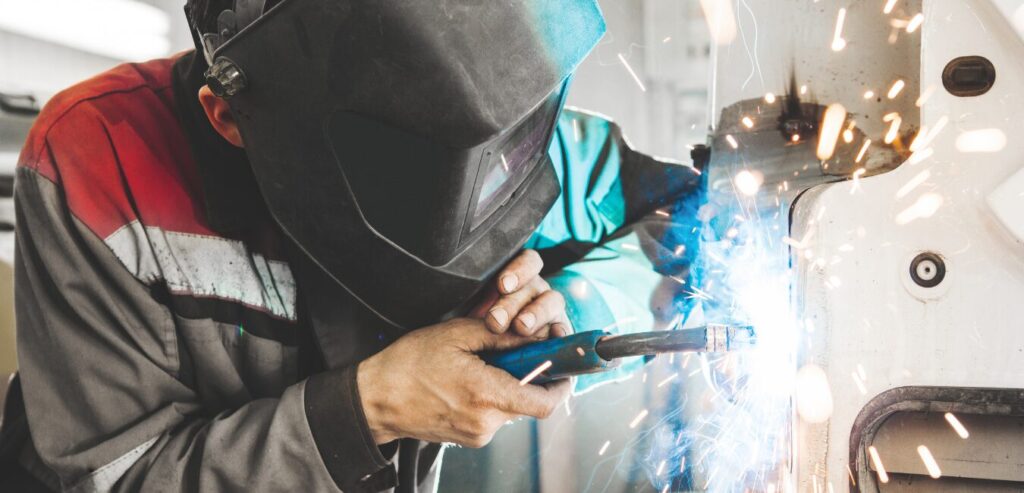
If you have ever finished a long weld and watched the metal bow, twist, or pull out of alignment, you have experienced distortion. It happens because metal expands when heated and contracts when cooled, and that expansion is never perfectly even across a joint. The backstepping welding technique is one of the oldest and most reliable ways to manage that thermal stress.
This post covers backstep welding explained in practical terms: what it is, how it works, when to use it, and what other welding distortion control methods you should know.
Backstep Welding Explained: How It Works
Instead of running one continuous bead from end to end, the backstepping welding technique breaks the weld into short segments (2 to 4 inches). You weld each segment in the direction opposite to your overall travel.
If the joint runs left to right:
- Start a few inches from the left edge and weld leftward to the edge
- Skip right past where you stopped and weld backward to meet the previous bead
- Skip right again, weld backward to tie in
- Repeat until the joint is complete
Each bead runs right to left, but the overall joint progresses left to right. This distributes heat more evenly instead of concentrating it at a single moving front. With backstep welding explained this way, the logic is clear: you are welding into metal that has already cooled, which balances contraction forces.
When to Use the Backstepping Welding Technique
Backstepping adds time to every joint, so it is not necessary on every weld. Use the backstepping welding technique when:
- The joint is long (over 12 inches), and distortion from a single continuous pass would pull the workpiece out of alignment
- You are welding thin material (under 1/4 inch) that is prone to warping
- The fit-up is tight, and there is no room for the workpiece to move
- You are welding near a finished surface or edge that cannot be straightened after
- The weld is structural, and the final dimensions need to be within tolerance
For short tack welds, small brackets, or thick material where distortion is minimal, backstepping is not needed. A continuous pass is faster and produces the same quality when warping is not a concern.
How to Reduce Welding Distortion: The Full Toolkit
Backstepping is one of several welding distortion control methods. Understanding how to reduce welding distortion means knowing which technique fits which situation. Here are the main approaches:
| Method | How It Works | Best For |
|---|---|---|
| Backstepping | Weld in short reverse segments | Long joints on thin to medium material |
| Balanced welding | Alternate welds on opposite sides of the joint | Double-sided joints, T-joints |
| Skip welding | Weld intermittent segments with gaps, fill in after | Long seams where continuous weld is not required |
| Pre-setting | Angle the parts before welding to compensate for expected shrinkage | Predictable distortion on known joint types |
| Clamping and fixturing | Physically restrain the workpiece during welding | Any joint where movement must be prevented |
| Heat sinks | Clamp copper or aluminum blocks to draw heat away | Thin sheet metal, small parts |
| Minimum weld size | Use the smallest bead that meets strength requirements | All joints, as a general practice |
Most experienced welders combine multiple welding distortion control methods on the same job. For example, clamping a workpiece in a fixture, using minimum weld size, and backstepping a long joint together give you far less distortion than any single technique alone.
How to Prevent Warping When Welding Thin Material
Thin sheet metal warps fastest because there is less mass to absorb heat. Knowing how to prevent warping when welding thin stock requires combining technique and setup:
- Use the lowest amperage and smallest wire diameter that gives adequate penetration
- Increase travel speed to reduce heat input per inch
- Use skip weld or backstep patterns on long seams
- Clamp the workpiece to a flat fixture or welding table
- Place copper or aluminum heat sinks behind the weld zone
- Allow cooling between passes
- Tack the full joint length before running continuous beads
The question of how to prevent warping when welding is really about managing heat input. Every technique on this list either reduces total heat or spreads it so contraction forces balance.
Backstepping vs. Other Sequence Methods
The backstepping welding technique is sometimes confused with skip welding. They are different.
Skip welding places segments with planned gaps, then fills the gaps on a second pass. All segments run the same direction. Skip welding is for long seams where a continuous weld is not structurally required.
Backstepping runs each segment in the opposite direction of overall travel, with each segment tying directly into the previous one. The final weld is continuous. Use backstepping when the joint needs to be fully welded, but a single pass would cause too much distortion.
Does Backstepping Affect Weld Quality
No. A backstep weld has the same strength as a continuous single-pass bead when the tie-in points overlap properly (about 1/4 inch). The only tradeoff is speed, since repositioning between segments takes time. On production work, weigh that time against the cost of straightening distorted parts.
Getting Set Up at CryoWeld
Understanding how to reduce welding distortion starts with good technique, but it also depends on having the right equipment. Lower heat input means a welding machine with precise voltage and wire speed control. Proper fixturing means quality clamps and cables. And clean, consistent beads require the right TIG torch, wire, and shielding gas.
CryoWeld carries Lincoln Electric, Tweco, and Weldcraft products and can help you match equipment to your welding needs. Stop by Poughkeepsie or Lake Katrine in the Hudson Valley. Call Poughkeepsie at (845) 473-3357 or Lake Katrine at (845) 336-8680, weekdays 8 to 5. Or visit cryoweld.com.
FAQs
What is the backstep welding technique?
Backstep welding explained simply: instead of welding a joint in one continuous pass, you break it into short segments (2 to 4 inches) and weld each one in the direction opposite to overall travel. Each segment ties into the previous one. The result is a continuous weld with more evenly distributed heat and less distortion.
How does backstepping reduce distortion in welding?
By welding into metal that has already cooled from the previous segment, the backstepping welding technique spreads contraction forces across the joint instead of concentrating them at a single moving heat front. This balances out the thermal stress that causes warping and bowing.
When should you use backstepping instead of welding straight through?
On long joints (over 12 inches), thin material prone to warping, tight fit-ups, and structural welds where final dimensions must stay within tolerance. Short tack welds, heavy material, and non-critical joints usually do not need it.
What other techniques reduce welding distortion besides backstepping?
Clamping and fixturing, balanced welding (alternating sides), skip welding, pre-setting the joint angle, using heat sinks, minimizing weld size, and increasing travel speed to lower heat input. Most fabricators combine multiple welding distortion control methods for the best results.
Does backstepping affect weld strength?
No. A backstep weld has the same strength as a continuous single-pass bead when the tie-in points overlap properly (about 1/4 inch). The only tradeoff is speed. Backstepping takes longer because of the repositioning between segments.