
How to Choose a Welding Helmet: Auto-Darkening, Shade, and Fit
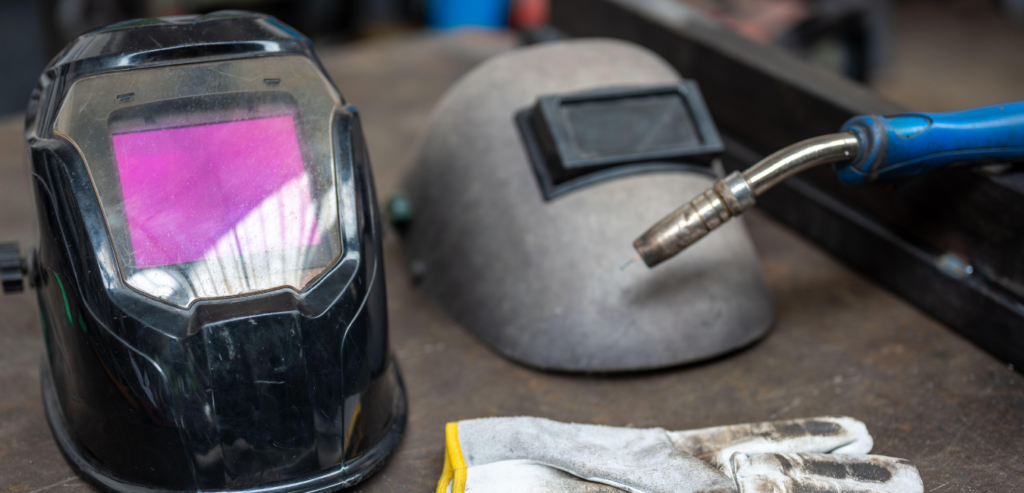
The best welding helmet for your shop depends on three things: the process you run, the shade range you need, and how the helmet sits on your head. Auto-darkening lenses, adjustable shade settings, and a solid fit separate a helmet that works all day from one that ends up in a drawer.
How Auto-Darkening Helmets Work
A fixed-shade helmet stays dark at all times, usually at shade #10. You flip it up to see the joint, position your torch or gun, then flip it down to strike. It works, but the constant lifting wears on your neck and makes it harder to hold position on the joint.
An auto-darkening welding helmet solves that problem. Light sensors on the lens detect the arc and darken the filter from a light state, usually shade #3 or #4, to your preset welding shade in milliseconds. You see the workpiece clearly with the helmet down, keep your hands in position, and strike without guessing where the joint is.
For shops running MIG, TIG, and stick on different materials throughout the day, auto-darkening cuts setup time and reduces weld defects caused by blind starts.
Welding Helmet Shade Number Guide
This welding helmet shade number guide covers the ANSI Z87.1 shade ratings for common processes. Shade level controls how much visible and infrared light reaches your eyes. Higher amperage produces a brighter arc, which calls for a higher shade number.
| Process | Typical Amperage | Recommended Shade |
|---|---|---|
| MIG | 60–200 A | #10–#12 |
| TIG | 15–200 A | #8–#13 |
| Stick | 60–250 A | #10–#13 |
| Oxy-fuel cutting | N/A | #3–#6 |
| Plasma cutting | 30–100 A | #8–#10 |
Most auto-darkening helmets offer a variable range from #9 to #13, which covers MIG, TIG, and stick at typical machine settings. If you also run oxy-fuel cutting with your gas apparatus, look for a helmet with a low-shade or grind/cut mode that drops below #9. Start at the shade recommended for your amperage and adjust up if the arc feels too bright or down if you cannot see the puddle clearly.
Fit, Weight, and Comfort
The best welding helmet for all-day work weighs between 18 and 21 ounces with a 4- or 5-point adjustable headgear that spreads weight across the top and sides of your head. Lighter helmets reduce neck strain over a full shift. Heavier ones with larger viewing areas can still work if the headgear balances the weight well.
Getting the right welding helmet fit for glasses wearers means checking clearance between the lens and your face. Some helmets sit too close and press frames into your nose or temples. Try the helmet on with your glasses before you buy. Magnifying cheater lenses are another option if you only need close-up clarity on the puddle and do not want to wear prescription frames under the hood.
Padding at the forehead and an absorbent sweatband make a noticeable difference on long shifts. Like any piece of safety equipment, a helmet only works if you actually wear it, and comfort is what keeps it on your head all day.
What to Look for Before You Buy
A few features separate the best welding helmet from a hobby-level one:
- Sensors: four sensors catch the arc from any angle, including out-of-position work. Two-sensor helmets handle bench welding, but miss flashes from the side.
- Switching speed: professional helmets darken in 1/25,000 of a second. Hobby helmets run 1/10,000 to 1/12,000. Faster switching reduces eye fatigue over a long shift.
- Viewing area: larger lenses give a wider field of view. Standard sizes run around 3.6 by 1.7 inches. Premium models go up to 3.8 by 2.4 inches or larger.
- Shade range: #9-#13 covers most arc welding. A #5-#13 range adds flexibility for cutting and low-amperage TIG.
- Battery: solar-powered with lithium backup is the most common setup. Helmets with replaceable batteries last longer overall.
- Grind mode: some helmets double as grinding shields with a clear or light shade setting, so you keep the helmet on through prep and cleanup.
Finding the Right Helmet in the Hudson Valley
CryoWeld carries auto-darkening and fixed-shade helmets at both locations. We can help you find the best welding helmet for your process, your budget, and your head. If you are not sure which shade range or feature set fits your work, bring in your current setup, and we will walk through the options.
We serve welders, fabricators, and contractors across Dutchess, Ulster, Orange, Putnam, Columbia, and Greene counties. Call our Poughkeepsie team at (845) 473-3357 or Lake Katrine at (845) 336-8680, weekdays 8 to 5. Or visit cryoweld.com.
Frequently Asked Questions
Is an auto-darkening welding helmet worth the cost?
For anyone welding more than occasionally, yes. The time saved by not flipping the helmet up and down adds up fast, and the ability to see the joint before striking leads to cleaner arc starts. Hobby welders on a tight budget can get by with a fixed shade, but most shops see a clear payback from the switch.
What shade should I use for MIG welding?
For most MIG work in the 60 to 200 amp range, shade #10 to #12 is standard. Higher amperages call for a darker shade. Start at #10 and adjust until the arc is comfortable to watch and the puddle is easy to read.
How do I get a good welding helmet fit for glasses?
Look for helmets with extra depth between the auto-darkening cartridge and your face. Several manufacturers design models for glasses wearers with wider cavities and adjustable lens-to-face distance. Cheater lens inserts are an alternative if you only need magnification at the weld.
What is the best welding helmet for beginners?
A mid-range auto-darkening helmet with a #9-#13 shade range, four sensors, and adjustable headgear covers most learning situations. You do not need the fastest switching speed or the widest viewing area when starting out, but variable shade and four sensors give you room to grow into different processes.
How long do auto-darkening helmets last?
Most auto-darkening helmets last 7 to 10 years with proper care. Solar-powered models with replaceable lithium backup batteries tend to last the longest because you can swap the battery when it weakens. Helmets with non-replaceable batteries generally run 5 to 7 years before the lens stops darkening reliably.