
How to Choose Welding Wire for the Process and Material You’re Running
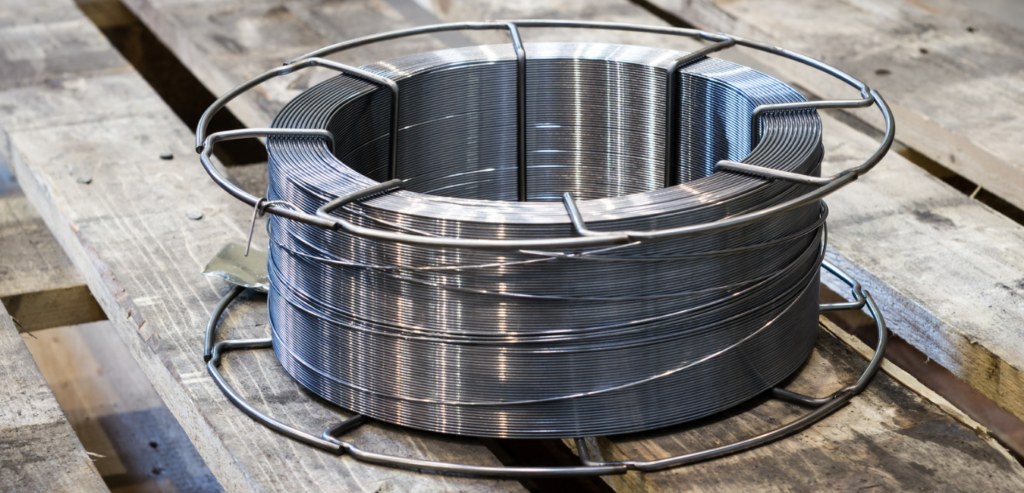
Picking the right welding wire comes down to three things: your process, your base metal, and the diameter your machine can handle. Get the match wrong, and you end up with porosity, poor fusion, or a bead that looks like it was laid down with a garden hose. Get it right, and the arc runs smooth, the puddle wets out flat, and the weld holds.
Match the Wire to Your Welding Process
Different processes use different types of wire, and the process you run narrows your choices before anything else does.
MIG (GMAW)
MIG uses a solid wire fed continuously through a gun with an external shielding gas. A solid MIG welding wire like ER70S-6 is the most common choice for mild steel. The “ER” stands for electrode and rod. The “70” is tensile strength in thousands of psi. The “S” means solid, and the “6” indicates higher silicon and manganese for better wetting and deoxidation.
Flux Core (FCAW)
Flux core uses a tubular wire with flux compound packed inside the sheath. Self-shielded flux core needs no external gas, which makes it a strong option for outdoor work and job sites where wind scatters shielding gas. Gas-shielded flux core runs with CO2 or a mixed gas and gives deeper penetration on thicker plate.
Stick (SMAW)
Stick uses a coated electrode rather than a spool of wire. It is a separate category, but shops that run both stick and MIG need the right consumables on hand for each machine.
Flux Core vs Solid Wire
The flux core vs solid wire question comes up in almost every shop that runs MIG. Both get the job done, but they fit different situations.
Solid MIG welding wire with a shielding gas produces cleaner welds with less spatter. It runs well on thin material and gives a smoother bead where appearance matters. Most indoor fab work runs on solid wire with a 75/25 argon-CO2 mix.
Flux core wins where you need penetration on heavier plate or where wind makes gas shielding unreliable. Self-shielded flux core does not need a gas cylinder on site, which cuts setup time on remote jobs. The trade-off is more spatter and more post-weld cleanup.
| Factor | Solid MIG Wire | Flux Core Wire |
|---|---|---|
| Shielding | External gas required | Self-shielded or gas-shielded |
| Spatter | Low | Moderate to high |
| Wind tolerance | Poor | Good (self-shielded) |
| Penetration | Moderate | Deep |
| Best for | Indoor fab, thin to medium plate | Outdoor, structural, heavy plate |
If your shop handles a mix of jobs, stocking both gives you the range to match wire to conditions.
Match the Wire to Your Base Metal
The wire alloy should match the base metal you are joining. Running the wrong wire leads to cracking, poor fusion, or a joint that corrodes faster than the parent material.
Mild Steel
ER70S-6 is the go-to for most MIG work on carbon steel. It handles light mill scale and surface contamination, wets out smoothly, and produces a clean bead. ER70S-3 works on cleaner material where less deoxidation is needed.
Stainless Steel
Match the wire to the stainless grade. ER308L covers 304 stainless. ER316L covers 316. The “L” means low carbon, which reduces the risk of carbide precipitation and intergranular corrosion at the weld.
Aluminum
ER4043 is the general-purpose choice for aluminum. ER5356 gives higher strength on structural alloys in the 5xxx series. Aluminum wire is softer than steel and feeds best through a spool gun or push-pull torch setup.
Wire Diameter for Welder Amperage
The wire diameter for welder amperage output determines how the arc behaves and how much heat goes into the joint. Thinner wire needs less current and suits lighter material. Thicker wire carries more amperage and fills heavier joints faster.
| Wire Diameter | Typical Amperage Range | Common Use |
|---|---|---|
| .023″ (0.6 mm) | 30–90 A | Sheet metal, auto body |
| .030″ (0.8 mm) | 40–145 A | General purpose, light fab |
| .035″ (0.9 mm) | 50–180 A | Medium plate, structural |
| .045″ (1.2 mm) | 75–250 A | Heavy fab, production welding |
For mig welding wire, .030 covers most general shop work on material up to 3/16 inch. Matching diameter to output is straightforward. Check your machine’s rated amperage, compare it to the table, and confirm the wire fits the drive rolls and contact tip in your gun. Running wire too thick for your machine starves the arc. Running wire too thin on heavy plate wastes time on extra fill passes.
What to Check Before You Buy
Before you order, run through this list:
- Process: MIG solid, flux core, or stick
- Base metal: mild steel, stainless, or aluminum
- Material thickness: drives wire diameter and amperage
- Shielding gas: CO2, argon mix, or self-shielded
- Machine output: match wire size to your amperage range
- Spool size: 2 lb, 11 lb, 33 lb, or 44 lb based on your volume
Keep your safety gear current when switching processes or wire types. Different wires produce different fume levels and spatter patterns, and your PPE should match the job.
Getting the Right Wire for Your Shop in the Hudson Valley
CryoWeld stocks MIG welding wire, flux core, and stick electrodes from trusted manufacturers at both locations. We match wire to your process, material, and machine so you buy what actually runs, not what sits on a shelf.
We serve welders, fabricators, and contractors across Dutchess, Ulster, Orange, Putnam, Columbia, and Greene counties. Call our Poughkeepsie team at (845) 473-3357 or Lake Katrine at (845) 336-8680, weekdays 8 to 5. Or visit cryoweld.com.
Frequently Asked Questions
What is the most common MIG welding wire for mild steel?
ER70S-6 is the standard for most shops running MIG on mild steel. It handles light surface contamination, wets out smoothly, and runs well on CO2 or argon-CO2 mixes. Most shops keep it on hand as their default spool.
When should I use flux core instead of solid wire?
Use flux core when you are welding outdoors, working on heavier plate, or welding in positions where deeper penetration helps. Self-shielded flux core also works where hauling gas cylinders to the job is not practical.
How do I know what wire diameter to run?
Match the wire to your machine’s amperage range and the thickness of your material. Thinner stock under 1/8 inch runs best with .023 or .030 wire. For plate 1/4 inch and above, move to .035 or .045. Your machine’s manual lists the recommended sizes.
Does shielding gas affect which wire I should use?
Yes. Solid MIG wire runs with an external gas, usually 75/25 argon-CO2 or straight CO2. Self-shielded flux-core wire runs without gas. Gas-shielded flux core needs CO2 or a mix. The wire and gas pairing affects arc stability, spatter, and bead shape.
Can I use the same wire for different metals?
No. Wire chemistry must match the base metal. Mild steel wire on stainless causes corrosion problems. Steel wire on aluminum will not produce a sound joint. Always match the wire alloy to the material you are welding.