
Fire Extinguisher Signage and Placement: What New York Code Requires
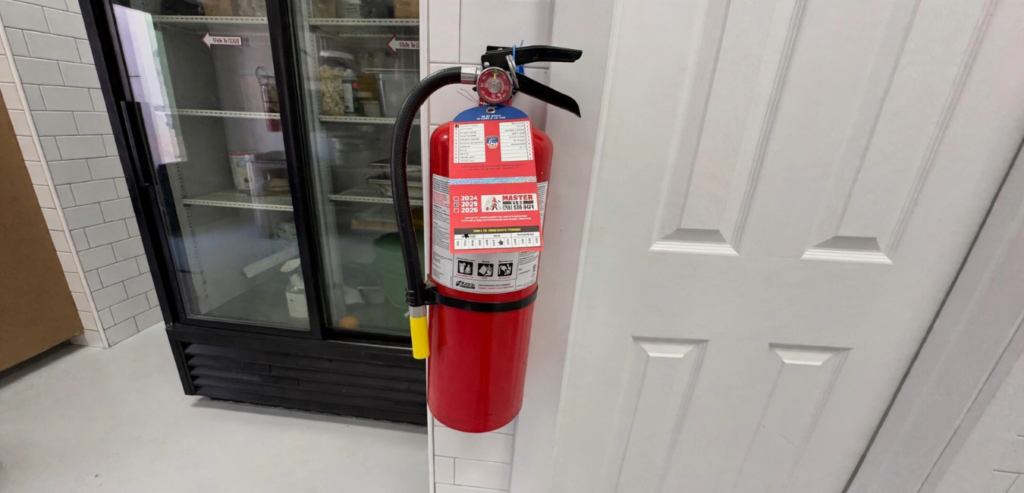
New York fire code sets specific rules for where fire extinguishers go, how high they mount, and when signs are required. Getting fire extinguisher placement requirements right avoids violations, fines, and, more importantly, makes sure the extinguisher is actually reachable when someone needs it. The rules come from the Fire Code of New York State (Section 906) and align with NFPA 10 standards.
Mounting height rules
Fire extinguisher mounting height code in New York follows a straightforward weight-based rule.
| Extinguisher weight | Maximum height (top of unit) | Minimum clearance (bottom) |
|---|---|---|
| 40 lb or less | 5 ft above the floor | 4 in above the floor |
| Over 40 lb | 3.5 ft above the floor | 4 in above the floor |
The “top of unit” measurement means the highest point of the extinguisher, not the bracket. Mount it so the carrying handle sits at a height where someone can lift it off the bracket without straining.
Fire extinguisher mounting height code applies to wall-mounted units, cabinet-mounted units, and any unit on a hanger or bracket per Section 906.7. Floor-standing wheeled units (Section 906.10) follow separate placement rules.
Travel distance requirements
Every point in the building must be within a maximum walking distance of a properly rated extinguisher. The maximum travel distance to a fire extinguisher depends on the hazard class.
Class A (ordinary combustibles)
The maximum travel distance to a fire extinguisher for Class A hazards is 75 feet. This applies to light, ordinary, and extra-hazard occupancies. Group A-5 spectator seating areas are exempt.
Class B (flammable liquids)
Travel distance drops to 30 or 50 feet depending on the extinguisher rating. Higher-rated units (40-B and above) allow the 50-foot distance. Lower ratings require 30 feet.
Class K (cooking equipment)
Install Class K extinguishers within 30 feet of commercial cooking equipment. This applies to restaurants, cafeterias, food trucks, and any commercial kitchen using vegetable oils or animal fats. A standard ABC extinguisher does not substitute for a Class K where cooking hazards exist.
Coverage by floor area
The number of extinguishers depends on occupancy type:
| Hazard level | Example | Floor area per extinguisher |
|---|---|---|
| Light (offices, churches) | Low combustible load | 3,000 sq ft |
| Ordinary (retail, warehouses) | Moderate combustible load | 1,500 sq ft |
| Extra (manufacturing, welding shops) | High combustible load | 1,000 sq ft |
A welding shop or fabrication facility falls under extra hazard, so you need one rated extinguisher for every 1,000 square feet of floor area. CryoWeld can help you figure out the count and types your facility needs.
Fire extinguisher sign requirements NY
Fire extinguisher sign requirements NY code addresses through Section 906.5 and 906.6 focus on visibility. The code requires extinguishers to be in conspicuous locations along normal paths of travel. When visual obstructions cannot be avoided, signage must indicate the location.
When signs are required
- When the extinguisher is not immediately visible from the normal path of travel
- When columns, equipment, inventory, or partitions block the line of sight
- When the extinguisher is inside a cabinet or recessed into a wall
When signs may not be required
- When the extinguisher is mounted on an open wall in full view of the travel path
- When nothing obstructs the line of sight from any approach direction
In practice, most commercial buildings and shops post signs above every extinguisher regardless of whether the code strictly requires it. It is a low-cost step that removes any question during an inspection.
What the sign should show
- A clear “Fire Extinguisher” label or the standard pictogram
- Mounted high enough to be visible above obstructions (typically 6 to 7 feet)
- Arrows or directional indicators if the extinguisher is around a corner or in an alcove
CryoWeld carries fire extinguisher signs and signage that meet New York code requirements.
Fire extinguisher placement requirements by type
Meeting fire extinguisher placement requirements means matching the right type to the right location. The wrong extinguisher in the right spot still fails an inspection.
| Location | Required type | Minimum rating |
|---|---|---|
| General office or retail | Class A | 2-A (light), 2-A (ordinary) |
| Manufacturing or welding shop | Class A | 4-A (extra hazard) |
| Flammable liquid storage | Class B | 10-B to 80-B depending on hazard |
| Commercial kitchen | Class K | Compatible with suppression system |
| Electrical equipment areas | Class C | Based on Class A or B hazard present |
Class C extinguishers are rated for electrical fires, but the code selects them based on the underlying Class A or B hazard. The extinguishing agent must be non-conductive.
Inspection and maintenance schedule
New York code follows NFPA 10 for ongoing maintenance:
- Monthly visual inspection: check mounting, accessibility, gauge pressure, physical damage, and tamper seal. Document by initialing the tag or keeping an electronic record.
- Annual service: internal inspection by an FDNY-approved or state-certified company. Includes pressure verification, agent examination, and a new service tag.
- 6-year maintenance: internal examination with agent replacement for applicable types.
- 12-year hydrostatic test: pressure test of the cylinder body (intervals vary by extinguisher type).
Service personnel must hold a valid certificate. Building owners can perform monthly visual checks, but annual and periodic maintenance must be done by certified professionals. This is part of the broader safety equipment compliance every commercial facility needs.
Getting compliant in the Hudson Valley
CryoWeld provides fire extinguisher sales, inspection, and maintenance at both our Poughkeepsie and Lake Katrine locations. We carry Class A, B, C, and K extinguishers plus the signs and brackets to mount them to code. If you are opening a new facility, expanding, or preparing for an inspection, we can walk through the fire extinguisher placement requirements for your space and make sure everything is where it needs to be.
We serve businesses across Dutchess, Ulster, Orange, Putnam, Columbia, and Greene counties. Call Poughkeepsie at (845) 473-3357 or Lake Katrine at (845) 336-8680, weekdays 8 to 5. Or visit cryoweld.com.
Frequently asked questions
How high should a fire extinguisher be mounted?
For extinguishers weighing 40 lb or less, the top should be no higher than 5 feet above the floor. For units over 40 lb, no higher than 3.5 feet. The bottom must be at least 4 inches off the floor. These rules come from the Fire Code of New York State, Section 906.9.
Does my business need a sign above every fire extinguisher?
Not always. New York code requires signage only when the extinguisher is not immediately visible from the normal path of travel. If a column, wall, or equipment blocks the view, a sign is required. In practice, posting a sign above every unit is a low-cost way to avoid questions during an inspection.
What is the maximum travel distance to a fire extinguisher?
For Class A hazards (ordinary combustibles), every point must be within 75 feet of a rated extinguisher. For Class B (flammable liquids), the distance is 30 to 50 feet depending on the extinguisher rating. For Class K (commercial cooking), 30 feet from cooking equipment.
What type of fire extinguisher does a welding shop need?
A welding shop is classified as extra hazard, which requires Class A extinguishers rated at least 4-A, with one per 1,000 square feet. If you store flammable liquids (solvents, acetylene), add Class B extinguishers rated for the hazard. Class C coverage may be needed near electrical panels and equipment.
How often do fire extinguishers need to be inspected in New York?
Monthly visual checks can be done by building staff. Annual service must be performed by a certified company. A 6-year internal examination and a 12-year hydrostatic test are also required, with intervals depending on extinguisher type. Keep records of every inspection.