
Best Welding Cables and Hoses for Heavy-Duty Shop Use
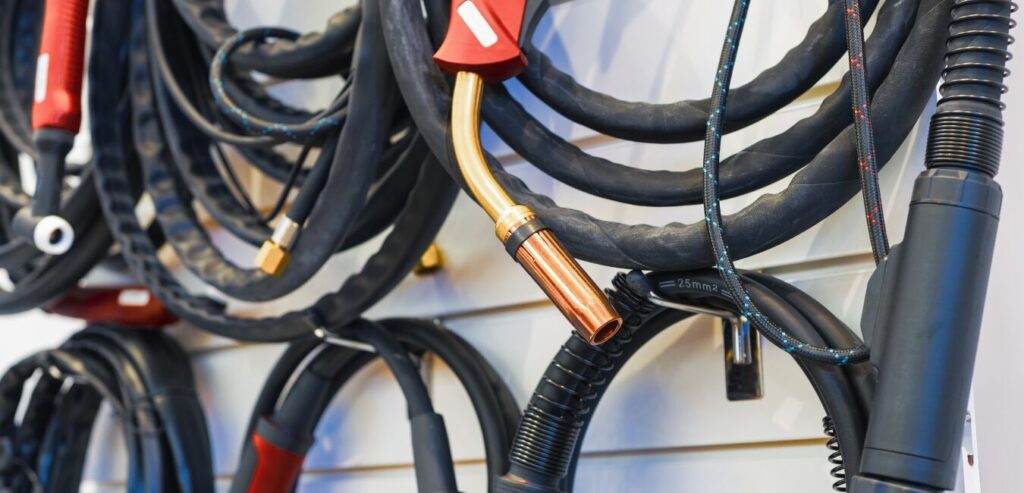
Cheap cables and hoses are the fastest way to turn a good welding machine into an unreliable one. An undersized cable drops voltage, overheats, and costs you arc quality before it costs you money on a replacement. A wrong-grade hose cracks, leaks gas, and puts your welds and your safety at risk. Picking the best welding cables and hoses for your shop means matching the gauge, insulation, and hose grade to the work you actually do.
This post covers how to size welding cable by amperage, the difference between Grade R and Grade T hose, and what to look for when you buy.
Welding Cable Gauge Guide: How to Size It
Welding cable is fine-stranded copper under thermoset rubber insulation (EPDM or Neoprene). It is built for the secondary circuit of a welder, from the machine to the electrode holder and work clamp. The three factors that determine the right gauge:
- Welder output amperage (the maximum amps your machine delivers)
- Total circuit length (electrode lead plus work lead together)
- Duty cycle (how many minutes out of ten the machine welds continuously)
Here is a welding cable gauge guide for common shop setups:
| Max Amperage | Up to 50 ft Circuit | 50–100 ft Circuit | 100–150 ft Circuit |
|---|---|---|---|
| 100A | #8 AWG | #6 AWG | #4 AWG |
| 150A | #6 AWG | #4 AWG | #2 AWG |
| 200A | #4 AWG | #2 AWG | #1 AWG |
| 250A | #2 AWG | #1 AWG | 1/0 AWG |
| 300A | #1 AWG | 1/0 AWG | 2/0 AWG |
| 400A | 1/0 AWG | 2/0 AWG | 3/0 AWG |
Circuit length is the total of both leads combined. A pair of 50-foot leads is a 100-foot circuit. Undersizing by one gauge might work at short lengths but causes voltage drop and overheating on longer runs. This welding cable gauge guide assumes a 60% duty cycle. Higher duty cycles push you one size larger.
For heavy-duty welding cable in production shops running 250 amps or more on long leads, start at #2 AWG minimum and go up from there. Class K stranding (30 AWG strands) is standard. Class M (34 AWG strands) is more flexible and worth the premium if your welders drag cable across the floor all day.
What Makes Heavy Duty Welding Cable Different
Not all welding cable is built the same. Heavy-duty welding cable for serious shop use shares a few characteristics:
- Thermoset rubber insulation (EPDM or Neoprene) that chars instead of melting when hit by weld spatter
- Fine-stranded copper (Class K or Class M) for flexibility under repeated coiling and dragging
- 600V rating (some light-duty cables are only rated 100V)
- 90°C or 105°C temperature rating
Heavy-duty welding cable with thermoplastic (PVC) insulation is cheaper but melts on contact with spatter and stiffens in cold weather. For any shop running MIG, TIG, or stick daily, thermoset rubber is the minimum standard.
CryoWeld carries welding cable in standard gauges cut to the length you need, along with lugs and connectors for proper termination.
MIG TIG Hose Grade R vs T
Gas hoses connect your regulator to your welding machine or torch. The two grades you will encounter are Grade R and Grade T, and they are not interchangeable for every application.
| Feature | Grade R | Grade T |
|---|---|---|
| Approved for | Fuel gas (acetylene, propane) and inert gas | Inert/non-flammable gas only (argon, CO2, nitrogen, helium) |
| Construction | Single or twin hose, reinforced rubber | Lighter construction, single hose |
| Color coding | Red (fuel), green (oxygen), or twin | Green, black, or blue |
| Common use | Oxy-fuel cutting and welding rigs | MIG shielding gas, TIG shielding gas |
| Pressure rating | Higher (typically 200 psi working) | Moderate (typically 100-200 psi) |
The MIG TIG hose grade R vs T distinction matters for safety. Grade R hose is rated for fuel gas and is required on any oxy-acetylene rig. Using Grade T hose on a fuel gas line is a fire and explosion hazard because Grade T is not tested for flammable gas service.
For MIG and TIG shielding gas lines (argon, CO2, helium, nitrogen), Grade T is the standard choice. It is lighter, more flexible, and costs less than Grade R because it does not need to meet fuel gas safety requirements.
If you run both oxy-fuel and MIG/TIG in the same shop, label your hoses clearly. The MIG TIG hose grade R vs T mix-up is most common when someone grabs the wrong hose from a shared rack.
How to Keep Cables and Hoses Lasting
Welding cables and hoses die from abuse, not age. A few habits extend their life:
- Inspect for cuts, burns, and exposed strands before each shift
- Replace damaged sections instead of wrapping them with tape
- Use lugs and connectors rated for fine-stranded conductors, crimped with the correct die
- Keep leads away from sharp edges, hot workpieces, and foot traffic
- Coil loosely. Tight coils under load build heat and weaken the insulation
- Store hoses out of direct sunlight to prevent rubber degradation
- Check hose fittings for leaks with soapy water after any reconnection
Heavy-duty welding cable that is properly maintained can last years. Cable that gets dragged over sharp edges and wrapped with electrical tape lasts months.
Getting Set Up at CryoWeld
CryoWeld stocks welding cable, gas hose, and connectors at both Hudson Valley locations. We also carry the welding machines, torches, gas cylinders, and safety equipment that your cables and hoses connect to.
Stop by Poughkeepsie or Lake Katrine. Call Poughkeepsie at (845) 473-3357 or Lake Katrine at (845) 336-8680, weekdays 8 to 5. Or visit our website.
Frequently Asked Questions
What welding cable gauge should I use for a 250-amp welder?
For a total circuit length under 50 feet, #2 AWG is the minimum. For 50 to 100 feet, step up to #1 AWG. For 100 feet or more, use 1/0 AWG. Always calculate both leads (electrode plus work clamp) for total circuit length.
Can I mix Grade R and Grade T hose on the same rig?
On an oxy-fuel rig, both fuel and oxygen lines must be Grade R. On a MIG or TIG setup using only inert shielding gas, Grade T is standard. Never use Grade T for fuel gas. If your shop runs both oxy-fuel and MIG/TIG, label every hose clearly to prevent mix-ups.
How do I know if my welding cable is undersized?
The cable feels hot to the touch during welding, the arc feels sluggish or inconsistent, and you notice voltage drop at the machine. These symptoms get worse with longer leads and higher duty cycles. Step up one gauge and see if the problem resolves.
What is the difference between Class K and Class M welding cable?
Class K uses 30 AWG strands and is the industry standard. Class M uses finer 34 AWG strands and is noticeably more flexible. Class M costs more but is worth it for welders who drag, coil, and reposition cable frequently throughout the day.
How often should welding cables and hoses be inspected?
Before every shift. Check for cuts, burns, exposed copper, cracked insulation, and loose connectors on cables. Check for cracks, leaks, and damaged fittings on hoses. Replace anything that fails visual inspection. Do not tape over damage on cables or hoses.
Can I use welding cable for permanent building wiring?
No. Most welding cable carries no UL listing and is not code-recognized for installation in conduit or cable tray. Inspectors will flag it. For permanent installations that need welding-cable flexibility, use a listed product like DLO or Type W cable.