
How to Choose a Welding Machine: The Honest Buying Guide for a First Machine
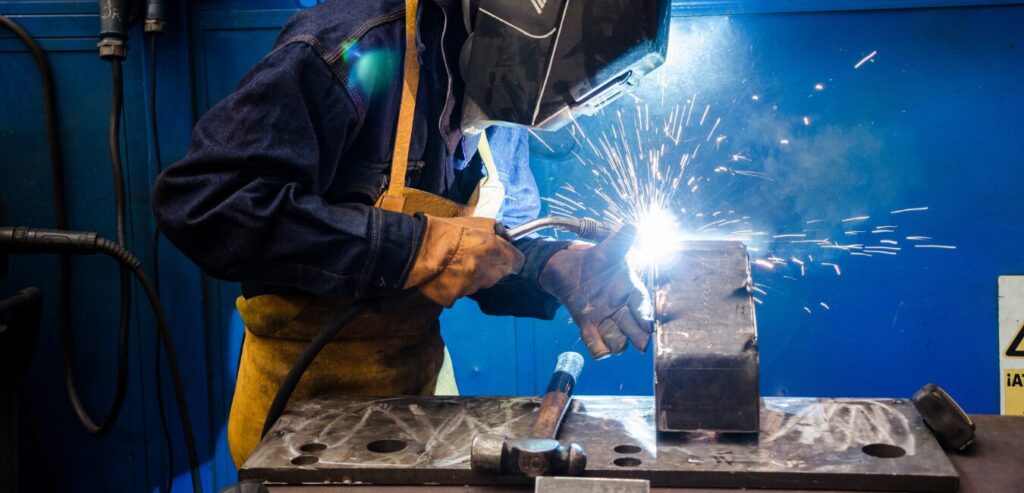
If you are asking what welder should I buy and the internet has given you twelve different answers, here is the honest version: the right machine depends on what you plan to weld, how thick it is, where you will work, and what you are willing to spend. There is no single best welding machine for beginners because beginners do different things.
This first welding machine buying guide breaks down the three main processes, matches them to common projects, and gives you a practical framework for picking a machine without overspending or underbuying.
MIG vs TIG vs Stick for Beginners
Before you pick a machine, you need to pick a process. Here is the MIG vs TIG vs stick for beginners comparison in plain terms:
| Factor | MIG | TIG | Stick |
|---|---|---|---|
| Learning curve | Easiest | Hardest | Moderate |
| Weld appearance | Clean, minimal cleanup | Cleanest, most precise | Rougher, requires slag removal |
| Speed | Fast | Slow | Moderate |
| Best for thin metal | Yes (down to 24 gauge) | Yes | No (18 gauge minimum) |
| Best for thick metal | Up to 3/8 in on 220V | Limited by machine size | Yes, any thickness |
| Outdoor use | Poor (wind disrupts gas) | Poor | Excellent |
| Needs shielding gas | Yes | Yes | No (flux provides shielding) |
| Equipment cost | Higher (machine + gas + wire) | Highest | Lowest |
MIG: The Default First Machine for Most People
MIG is the most forgiving process to learn. Pull a trigger, and the wire feeds automatically. Settings are simple, cleanup is minimal. If you are doing shop work on mild steel, stainless, or aluminum (with a spool gun), MIG covers the widest range of projects.
The downside: MIG needs shielding gas, which means a cylinder and a regulator. Wind kills a MIG gas shield, so this is an indoor process.
TIG: Precision First, Speed Second
TIG produces the cleanest, most controlled welds. It is the process of choice for thin sheet, pipe, and anything where appearance matters. But TIG has the steepest learning curve, and most beginners are not ready for it as a first machine unless they have a specific reason to learn it.
Stick: The Budget-Friendly Field Option
Stick is the cheapest way into welding. The machines are simple, there is no gas to buy, and the process works outdoors in wind. It handles dirty, rusty, and painted metal better than MIG or TIG. The tradeoff is more spatter, more cleanup, and it does not work on thin material.
For anyone asking what welder should I buy for farm repairs, fencing, or outdoor maintenance, stick is often the right answer.
How to Choose a Welding Machine by Project Type
No first welding machine buying guide can tell you what to buy without knowing what you plan to weld. The best welding machine for beginners depends on the projects you tackle most often:
| Typical Project | Material Thickness | Recommended Process |
|---|---|---|
| Auto body, sheet metal | 24 gauge to 3/16 in | MIG |
| Trailer frames, fencing | 1/4 in to 5/16 in | MIG or stick |
| Farm and ranch repair | 5/16 in to 3/8 in | Stick or MIG (220V) |
| Heavy structural | Over 3/8 in | Stick |
| Bicycles, tube frames | 1/16 in | TIG |
| Exhaust, artistic metalwork | 1/16 in to 1/8 in | TIG |
If 80 percent of your work is indoor shop welding on mild steel under 3/8 inch, a MIG machine is the best welding machine for beginners in that situation. If your work is mostly outdoors on heavier material, stick makes more sense. If precision on thin material is the priority, TIG is worth the learning curve.
What to Look for When Buying
Once you know your process, here is how to choose a welding machine that will not leave you frustrated or outgrown in a year.
Amperage Range
A general rule: you need about 1 amp per .001 inch of material thickness. For 1/8 inch steel, that is 125 amps. For 1/4 inch, 250 amps. Buy a machine with enough amperage ceiling for the thickest material you expect to weld. Going slightly over is better than running your machine at maximum output constantly.
Input Power
Most home shops have 110V (120V) outlets. Some have 220V (240V). This matters because:
- 110V machines typically max out around 140 amps, enough for material up to about 3/16 inch
- 220V machines reach 200+ amps and handle material up to 3/8 inch or more
If you only have 110V now but might upgrade later, look for a dual-voltage machine that accepts both.
Duty Cycle
Duty cycle is the minutes out of ten that the machine can weld continuously at a given amperage before cooling. A 30% duty cycle at 200 amps means three minutes welding and seven minutes cooling. For hobby and home shop use, 20 to 30 percent is usually enough. Production work needs 60 percent or higher.
Multi-Process Capability
Some machines handle MIG, stick, and TIG from a single unit. A multi-process machine running MIG for daily work and stick for field repairs covers most situations a first-time buyer will face. CryoWeld carries Lincoln Electric welding machines in all configurations at both locations.
What Else You Need Besides the Machine
Budget for these on top of the machine price:
- Shielding gas cylinder and regulator (MIG and TIG only)
- Welding wire or filler rod matched to your base metal
- Auto-darkening welding helmet, leather gloves, flame-resistant clothing
- Wire brush, chipping hammer, angle grinder
- Cables if not included with the machine
- Clamps or welding table for workholding
Getting Your First Machine at CryoWeld
If you are still asking what welder should I buy, the fastest way to an answer is talking to someone who sells and repairs these machines daily. CryoWeld carries Lincoln Electric MIG, TIG, stick, and multi-process machines along with torches, consumables, gas, and safety gear. We also do in-house repair when your machine needs service.
Stop by Poughkeepsie or Lake Katrine in the Hudson Valley. Call Poughkeepsie at (845) 473-3357 or Lake Katrine at (845) 336-8680, weekdays 8 to 5. Or visit our website.
FAQs
What is the best welding machine for a beginner?
For most beginners doing indoor shop work on mild steel, a MIG welder is the best welding machine for beginners. It is the easiest process to learn and produces clean welds with minimal cleanup. If your work is primarily outdoors or on heavy material, a stick welder is a better starting point.
Should a beginner buy a MIG or stick welder first?
MIG if you work indoors on clean material and want the easiest learning curve. Stick if you work outdoors, need portability, or weld on dirty and rusty metal. In the MIG vs TIG vs stick for beginners comparison, MIG wins for shop work and stick wins for field work.
How much should you spend on a first welding machine?
A capable MIG machine for home shop use starts around $400 to $600 for a 110V unit. A 220V MIG or multi-process machine runs $700 to $1,200. Add $150 to $300 for gas, wire, helmet, and gloves. Stick machines start lower, around $200 to $400, with fewer accessories needed.
What amperage welding machine do I need for general home use?
A machine with at least 140 amps handles material up to about 3/16 inch. For 1/4 inch material, you need 200+ amps (typically a 220V machine). If you might work on thicker material in the future, buy more amperage now rather than replacing the machine later.
What is the difference between a single-phase and three-phase welding machine?
Single-phase machines run on standard household or shop power (110V or 220V). Three-phase machines require industrial power that most homes and small shops do not have. For a first machine, single-phase is almost always what you need. Three-phase machines are for heavy industrial production environments.