
What OSHA Requires for Welding Safety in a Commercial Shop
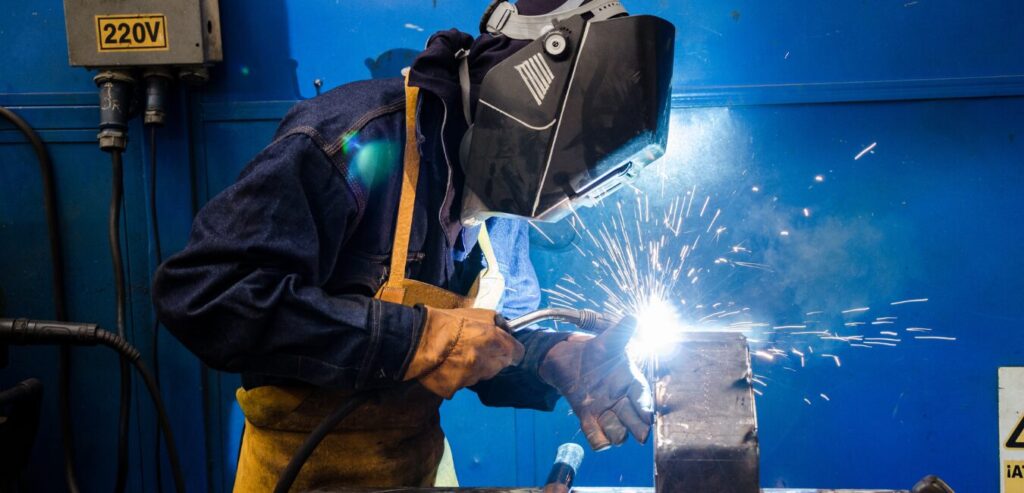
OSHA does not treat welding safety as optional. The standards under 29 CFR 1910 Subpart Q spell out exactly what a commercial welding shop must do to protect workers from fumes, burns, electric shock, and fire. If your shop welds, cuts, or brazes, these OSHA welding safety requirements apply to you. Inspectors enforce them, and violations carry real fines.
This post covers the core OSHA standards for welding that every shop owner, supervisor, and welder in the Hudson Valley should know.
What OSHA 1910 Welding Requirements Cover
The OSHA 1910 welding requirements for general industry fall under 29 CFR 1910.252 through 1910.255. Here is what each section addresses:
| Standard | Covers |
|---|---|
| 1910.252 | General requirements: fire prevention, ventilation, PPE, confined spaces |
| 1910.253 | Oxygen-fuel gas welding and cutting |
| 1910.254 | Arc welding and cutting |
| 1910.255 | Resistance welding |
For most commercial shops running MIG, TIG, or stick processes, 1910.252 and 1910.254 are the sections that matter most. These OSHA 1910 welding requirements set the baseline for everything from ventilation to fire watch procedures.
Ventilation Rules
OSHA requires mechanical ventilation for welding when:
- The space is less than 10,000 cubic feet per welder
- Ceiling height is under 16 feet
- Partitions or barriers block cross-ventilation
Minimum rate: 2,000 cubic feet per minute per welder. Local exhaust hoods must maintain 100 linear feet per minute of airflow at the welding zone.
For specific metals, the OSHA standards for welding add stricter controls:
- Stainless steel: local exhaust required for all production welding
- Galvanized steel: local exhaust required indoors
- Lead-coated surfaces: local exhaust or airline respirators
- Cadmium and beryllium: local exhaust and airline respirators unless monitoring confirms safe levels
Personal Protective Equipment
OSHA welding safety requirements for PPE are set under 1910.252(b) and reference the general PPE standard at 1910.132. Here is what is required:
| PPE Category | OSHA Requirement |
|---|---|
| Eye/face | Welding helmet with correct shade for the process; safety glasses underneath |
| Body | Flame-resistant clothing; no synthetic fabrics that melt |
| Hands | Insulated leather welding gloves |
| Feet | Steel-toe or composite-toe boots |
| Respiratory | Required when ventilation cannot keep exposure below PEL |
The shade number on the helmet lens must match the welding process and electrode size. OSHA provides a shade selection guide in 1910.252(b)(2)(ii)(H). For shielded metal arc welding with 1/8-inch electrodes, that is shade 10. For gas-shielded arc welding on ferrous metals, shade 12.
CryoWeld carries Jackson Safety helmets, Tillman gloves, and flame-resistant clothing that meet these OSHA standards for welding.
Fire Prevention and Fire Watch
Fire prevention is the largest section of the welding shop safety regulations, and it is where most violations occur. The core rules under 1910.252(a):
- Movable combustibles must be relocated at least 35 feet from the welding area
- If combustibles cannot be moved, cover them with fire-resistant shields
- Fire watch is required whenever combustibles are within 35 feet and cannot be fully removed
- Fire watch continues for at least 30 minutes after welding stops
- Fire extinguishing equipment must be maintained ready for instant use
For commercial welding shop compliance, every shop should have a written hot work permit system for welding outside designated areas. CryoWeld provides fire extinguisher inspection to keep shops current.
Gas Cylinder Storage and Handling
The welding shop safety regulations for compressed gas cylinders fall under 1910.253 and are among the most commonly cited:
- Cylinders must be stored upright and secured to prevent tipping (chain, strap, or rack)
- Oxygen and fuel gas cylinders must be separated by at least 20 feet or by a 5-foot noncombustible barrier
- Cylinder valves must be closed when not in use
- Valve protection caps must be in place during storage and transport
- Cylinders must not be stored near heat sources, combustibles, or in direct sunlight
- Cylinders must be within their retest dates to be legally filled
CryoWeld supplies gas cylinders that are current on testing and properly labeled, and we handle cylinder recertification at our Poughkeepsie facility.
Equipment Inspection
Under 1910.254, arc welding equipment must be inspected before use:
- All cables, connectors, and electrode holders must have intact insulation
- Damaged equipment must be removed from service immediately
- Welding machines must be properly grounded
CryoWeld does in-house repair on welding machines and torches and carries replacement cables and torches for equipment that fails inspection.
What Violations Cost
OSHA penalty ranges as of 2024 for welding shop safety regulations violations:
| Violation Type | Penalty Range |
|---|---|
| Serious | Up to $16,131 per violation |
| Willful or repeated | Up to $161,323 per violation |
| Failure to abate | Up to $16,131 per day |
Commercial welding shop compliance is not just about avoiding fines. An OSHA inspection that finds missing fire extinguishers, blocked ventilation, or workers without proper PPE can shut down operations until corrections are made. The cost of downtime usually exceeds the fine itself.
Staying Compliant in the Hudson Valley
Meeting OSHA 1910 welding requirements is not complicated once you have the right equipment, the right procedures, and a supplier who keeps your safety gear and fire protection current. CryoWeld supplies welding machines, welding safety equipment, fire extinguishers, and shielding gas to shops across the Hudson Valley and Western Connecticut. We also handle fire extinguisher inspections and cylinder testing, so your commercial welding shop compliance stays up to date.
Call Poughkeepsie at (845) 473-3357 or Lake Katrine at (845) 336-8680, weekdays 8 to 5. Or visit cryoweld.com.
FAQs
What are the OSHA requirements for welding in a commercial shop?
OSHA 29 CFR 1910 Subpart Q requires adequate ventilation, proper PPE (helmet, gloves, flame-resistant clothing), fire prevention measures including a 35-foot combustible clearance zone, fire watch procedures, proper gas cylinder storage, and equipment inspection before use. Written hot work permits are required for welding outside designated areas.
Does OSHA require ventilation for welding operations?
Yes. Mechanical ventilation is required when the welding space is under 10,000 cubic feet per welder, ceiling height is below 16 feet, or structural barriers block airflow. The minimum rate is 2,000 CFM per welder. Local exhaust is required for welding stainless steel, galvanized steel, lead, cadmium, and beryllium.
What PPE does OSHA require for welders?
A welding helmet with the correct shade for the process, safety glasses underneath, flame-resistant clothing, insulated leather gloves, and steel-toe boots. Respiratory protection is required when engineering controls cannot keep fume exposure below permissible limits.
What are the OSHA rules for storing gas cylinders in a welding shop?
Cylinders must be stored upright and secured against tipping. Oxygen and fuel gas must be separated by 20 feet or a 5-foot noncombustible barrier. Valves must be closed when not in use, and protection caps must be in place during storage and transport. Cylinders must be kept away from heat sources and combustibles.
What are the penalties for OSHA welding violations?
Serious violations carry penalties up to $16,131 per violation. Willful or repeated violations can reach $161,323 per violation. Failure to correct a cited violation adds up to $16,131 per day. Beyond fines, violations can trigger operational shutdowns until corrections are verified.