
CO2 vs. Argon for MIG Welding: Choosing the Right Gas
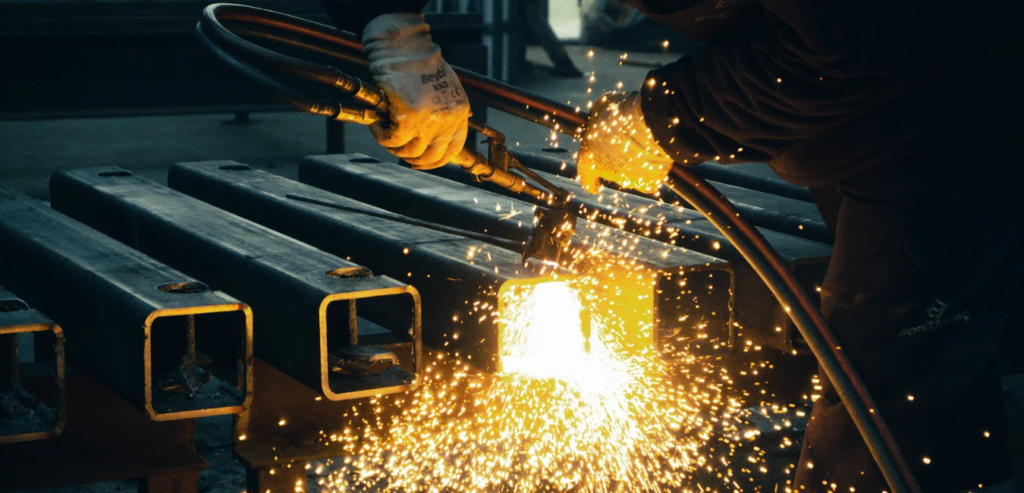
The best gas for MIG welding mild steel in most shops is a 75/25 argon-CO2 blend. It gives you solid penetration, a stable arc, and manageable spatter. But that is not the only option, and the right MIG welding gas depends on the material, the thickness, and the finish you need. Straight CO2 and pure argon each have a place. Picking the wrong one costs you in cleanup, consumables, or weld quality.
How Shielding Gas Affects Your MIG Weld
Every MIG welding gas does two jobs: it keeps atmospheric contamination out of the weld pool, and it changes how the arc behaves. The gas you run affects penetration depth, spatter levels, bead appearance, and how much post-weld cleanup you are looking at.
Inert gases like argon do not react with molten metal. Reactive gases like CO2 interact with the puddle and generate extra heat. That chemical difference is why the CO2 vs argon MIG welding debate is not just a price question. Each gas produces a different arc, a different bead profile, and a different amount of work after the weld is done.
Straight CO2 Welding Gas: Deep Penetration, More Spatter
Straight CO2 welding gas is the cheapest shielding gas option for MIG welding carbon steel. It produces deeper penetration than argon, which makes it useful on thicker material where fusion at the root matters more than bead appearance.
The trade-offs show up fast:
- Heavy spatter that coats the workpiece and clogs the nozzle
- A rougher, more erratic arc that is harder to control
- More surface oxidation on the finished weld
- Higher consumable replacement costs from nozzle and tip wear
Straight CO2 welding gas works for structural steel, heavy plate, and jobs where grinding is already part of the process. If you are running production welds on clean material and care about appearance, it is not the right choice.
CO2 is a reactive gas and should not be used on aluminum or stainless steel.
Pure Argon: Smooth Arc, Limited Use on Steel
Pure argon delivers a stable, focused arc with almost no spatter. It is the standard shielding gas for aluminum and other non-ferrous metals, and it is required for TIG welding across most materials.
On carbon steel, pure argon creates problems. Penetration is shallow and narrow. The weld pool does not wet out properly at the toes, which leads to lack-of-fusion defects. That is why you will rarely see a fabrication shop running pure argon on mild steel with MIG.
Where pure argon fits in a MIG setup:
| Application | Why Argon Works |
|---|---|
| Aluminum MIG (spool gun) | Inert protection prevents oxidation |
| Non-ferrous metals (copper, bronze) | No reactive gas interference |
| TIG welding (all materials) | Clean, stable arc for precision work |
Argon-CO2 Blends: The Shop Standard
For most carbon steel MIG work, the best gas for MIG welding mild steel is an argon-CO2 blend. The argon provides arc stability and spatter control. The CO2 adds enough heat for proper penetration. The result is a clean bead with good fusion and less cleanup than straight CO2.
Here are the common ratios and what they do:
| Blend | Best For |
|---|---|
| 75% Ar / 25% CO2 | General carbon steel fabrication, structural work |
| 80% Ar / 20% CO2 | Thinner steel, cleaner bead appearance |
| 85% Ar / 15% CO2 | Sheet metal, automotive panels, light gauge |
| 90% Ar / 10% CO2 | Short-circuit transfer on thin material |
Higher CO2 content means deeper penetration and more spatter. Higher argon content means a smoother arc and cleaner finish, but less penetration. Most shops running mild steel between 1/8 and 3/8 inch land on 75/25 and stay there.
For stainless steel MIG welding, a tri-mix blend (helium, argon, and a small percentage of CO2) or a 98/2 argon-CO2 mix is standard. The lower CO2 content reduces carbon pickup that would compromise corrosion resistance.
How to Pick the Right MIG Welding Gas for Your Job
The CO2 vs argon MIG welding decision comes down to three factors.
| Factor | Points Toward CO2 | Points Toward Argon Blend |
|---|---|---|
| Material thickness | 3/8 in. and up | Under 3/8 in. |
| Weld appearance | Not critical | Matters for the finished product |
| Post-weld cleanup budget | Grinding already planned | Minimal cleanup preferred |
If you weld mostly carbon steel under 3/8 inch thick and want a good-looking bead without heavy grinding, a 75/25 argon-CO2 mix is your MIG welding gas. If you are cutting and welding heavy structural plate where the weld gets painted over anyway, straight CO2 welding gas saves money on gas costs without hurting the joint.
CryoWeld stocks argon, CO2, and pre-mixed argon-CO2 cylinders in multiple sizes. We also offer bulk gas delivery for shops running high volume across the Hudson Valley and Western Connecticut.
Getting the Right Shielding Gas in the Hudson Valley
Picking the right MIG welding gas should not require guesswork. Our counter staff at both locations can match you to the correct gas based on your process, your material, and your welding machine setup. We carry cylinder sizes from small portables to full-size tanks, with exchange and refill options for shops in Dutchess, Ulster, Orange, Putnam, and Columbia counties. Stop by either location to see what we have in stock.
Need help choosing between CO2 vs. argon MIG welding setups? Call our Poughkeepsie team at (845) 473-3357 or Lake Katrine at (845) 336-8680, weekdays 8 to 5. Or visit cryoweld.com.
Frequently Asked Questions
What is the best shielding gas for MIG welding mild steel?
A 75/25 argon-CO2 blend is the most common choice for MIG welding mild steel. It balances penetration, arc stability, and spatter control. Shops welding thinner material may prefer 80/20 or 85/15 for a cleaner bead with less heat input.
Can you MIG weld with straight CO2?
Yes. Straight CO2 welding gas works on carbon steel and gives deeper penetration than argon blends. The tradeoff is heavier spatter, a rougher bead, and more post-weld cleanup. It is a cost-effective option for heavy structural work where appearance is secondary.
Why not use pure argon for MIG welding steel?
Pure argon produces shallow, narrow penetration on carbon steel. The weld pool does not wet out at the edges, leading to lack-of-fusion defects. Argon works well for MIG welding aluminum and for TIG welding, but it is not suited to steel MIG work without CO2 blended in.
What gas do you use for MIG welding stainless steel?
A tri-mix blend of helium, argon, and CO2 is common for stainless steel MIG welding. A 98/2 argon-CO2 mix also works. The low CO2 content prevents excess carbon from entering the weld, which would reduce corrosion resistance.
Does the shielding gas affect MIG welding spatter?
Yes. Straight CO2 produces the most spatter. Adding argon to the mix reduces spatter significantly. An 85/15 or 90/10 argon-CO2 blend produces the least spatter on steel, but also reduces penetration. The right blend balances spatter control with the penetration your joint needs.
How do I know when my shielding gas cylinder is low?
Check the pressure gauge on your regulator. A full cylinder reads around 2,000 psi for argon or argon blends. CO2 reads around 830 psi at room temperature. When pressure drops below 200 psi, swap or refill. Running out mid-weld introduces porosity into the joint.