
Argon Tank Sizing for TIG Welding: A Buyer’s Guide
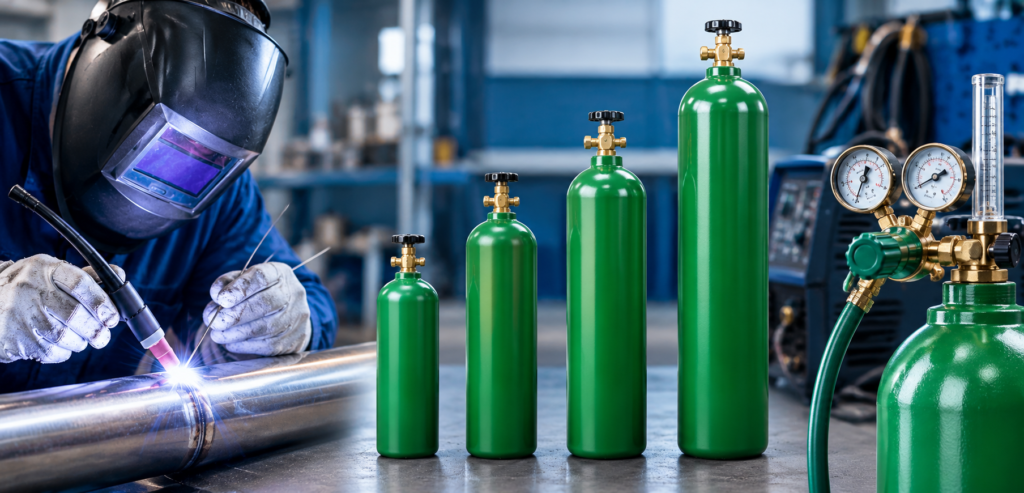
The most common argon tank sizes for TIG welding are 40, 80, and 125 cubic feet. An 80 cf cylinder works for most shop welders. It holds enough gas for several hours of TIG work without being too heavy to move around the floor. The right size depends on how often you weld, what materials you run, and how much space you have.
Common Cylinder Sizes for TIG Welding
TIG welding uses 100% argon as the shielding gas for steel, stainless steel, and aluminum. The cylinder you pick determines how long you can weld between refills and how easy the tank is to handle.
Here is a breakdown of standard cylinder sizes and what fits each setup:
| Size | Height | Weight (empty) | Best For |
|---|---|---|---|
| 40 cf | 18 to 23 in. | 22 to 24 lbs | Portable work, light-duty TIG |
| 80 cf | 31 to 36 in. | 39 to 47 lbs | Home shops, regular welding |
| 125 cf | 42 to 48 in. | 51 to 65 lbs | Fabrication shops, daily use |
| 200+ cf | 48 to 55 in. | 90 to 143 lbs | High-volume production |
Argon tank sizes are measured in cubic feet of gas at standard pressure. Dimensions vary by manufacturer, so check the actual height and diameter before buying if the cylinder needs to fit a specific welding cart.
Matching Cylinder Size to Your TIG Setup
Choosing what size argon tank for TIG welding starts with how often you strike an arc.
If you TIG weld a few times a month for repairs or small projects: a 40 cf cylinder keeps things light and portable. You will refill more often, but the smaller size stores easily and moves without a cart.
If you weld weekly or run a home shop: 80 cf is the go-to choice. It gives you roughly four hours of continuous gas flow at 20 cfh and fits most welding carts.
For fabrication shops welding every day: 125 cf or larger cuts down trips to the supplier. Shops running through cylinders quickly can set up bulk gas delivery to skip the exchange cycle entirely.
Argon for Aluminum TIG Work
An argon tank for aluminum TIG should be filled with 100% pure argon, the same gas used for steel and stainless TIG. The difference is not in the gas itself but in how much you use.
Where the argon tank for aluminum TIG matters most is in cup selection. Larger gas lens setups and oversized cups pull more gas per minute. If you run a number 12 or larger cup regularly, your argon tank for aluminum TIG will empty faster than the same cylinder on steel with a standard nozzle.
An 80 cf or 125 cf cylinder covers most aluminum work. If you weld aluminum with large cups on a regular basis, size up so you are not swapping mid-project. CryoWeld carries argon cylinders compatible with all TIG torch and accessory setups.
How Long a Cylinder Lasts at Different Flow Rates
How long a cylinder lasts depends on your gas flow rate. TIG welding typically runs between 15 and 25 cfh. Here is the approximate continuous welding time for each size:
| Flow Rate | 40 cf | 80 cf | 125 cf |
|---|---|---|---|
| 15 cfh | 2.7 hrs | 5.3 hrs | 8.3 hrs |
| 20 cfh | 2.0 hrs | 4.0 hrs | 6.3 hrs |
| 25 cfh | 1.6 hrs | 3.2 hrs | 5.0 hrs |
These are continuous flow times. You will get more total shop time because TIG welding includes breaks for positioning, tacking, cleaning, and fitting. Pre-flow and post-flow settings also add to gas consumption.
Check your regulator gauge before starting a project. A full argon cylinder reads around 2,000 psi. When pressure drops below 200 psi, it is time for a refill or exchange.
Getting Your Cylinders in the Hudson Valley
CryoWeld stocks argon cylinders in sizes from small portables to full-size tanks, with exchange and refill options at both locations. Whether you need a 40 cf for field repairs or a 125 cf for your fabrication shop, our counter staff can match you to the right cylinder and set up an exchange schedule that keeps you welding.
We serve fabricators and welders across Dutchess, Ulster, Orange, Putnam, and Columbia counties. Call our Poughkeepsie team at (845) 473-3357 or Lake Katrine at (845) 336-8680, weekdays 8 to 5. Or visit cryoweld.com.
Frequently Asked Questions
Can I use the same argon cylinder for MIG and TIG?
Yes. A standard argon cylinder with a CGA-580 valve works for both processes. For MIG welding steel, most shops use an argon-CO2 blend rather than pure argon. If you run both processes, you may need separate cylinders for each gas type.
How do I know when my cylinder needs a refill?
Check the high-pressure gauge on your regulator. A full argon cylinder reads around 2,000 psi. As you use gas, pressure drops proportionally. When it falls below 200 psi, swap or refill to avoid running out during a weld.
Is a bigger cylinder always the better choice?
Not always. Larger cylinders hold more gas and cost less per cubic foot to refill, but they are heavier and take up more floor space. For shops with limited room or welders who need portability, an 80 cf cylinder is usually the best balance.
What argon flow rate should I use for TIG?
Most TIG welding on steel and aluminum runs between 15 and 25 cfh. Start at 15 to 20 cfh with a standard cup in a draft-free area. Increase flow if you use a larger gas lens or cup, or if air movement around the weld is a factor.
Does CryoWeld exchange or refill argon cylinders?
CryoWeld offers both exchange and refill on argon cylinders at the Poughkeepsie and Lake Katrine locations. Bring in an empty; pick up a full one in the same size. Multiple sizes are available with no long-term rental contracts required.